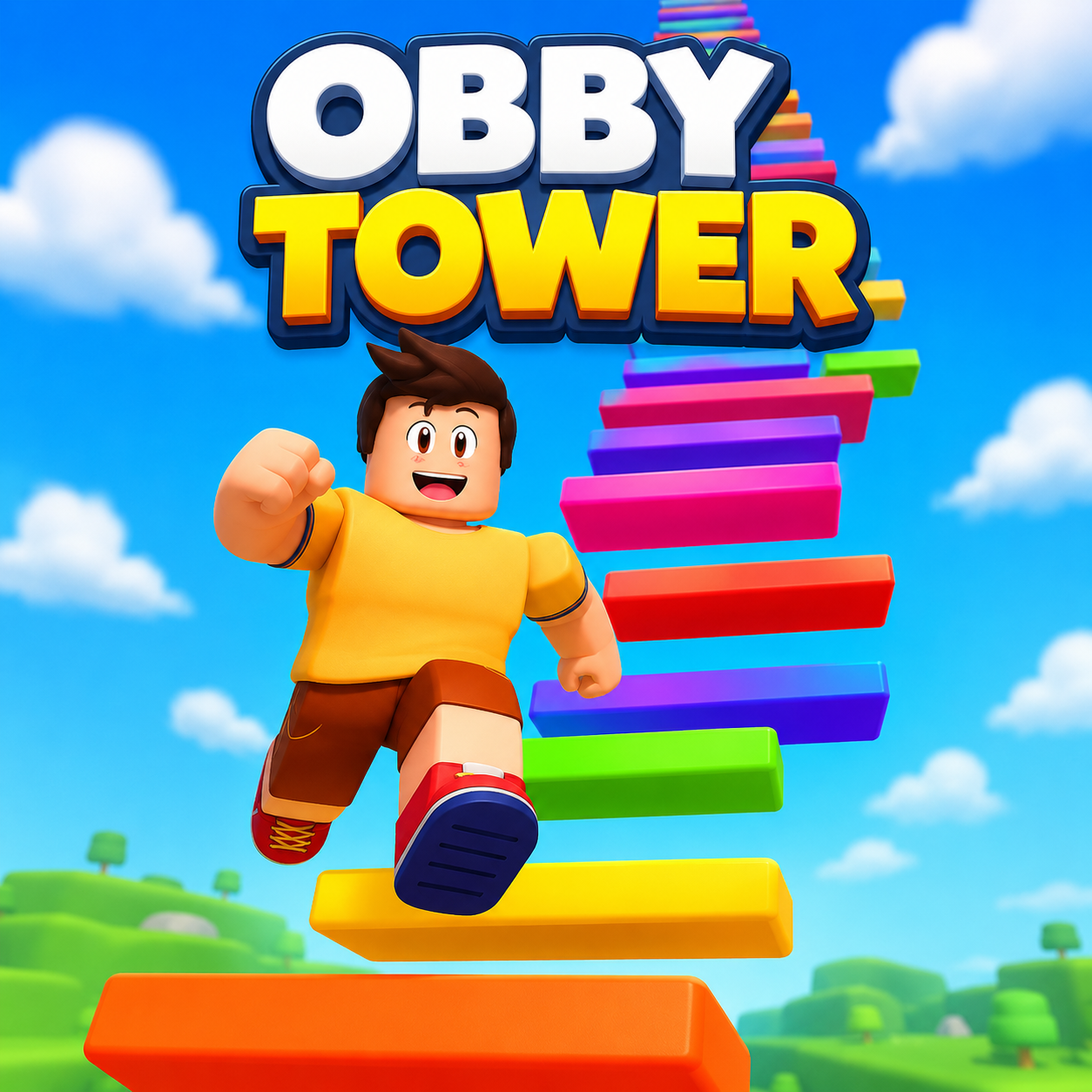
Obby Tower
Obby Tower Mods Game





How To Play Obby Tower
The fundamental gameplay cycle of Obby Tower centers on traversing a suspended realm through exact leaps, regulated dashes, and deliberate problem-solving. Prior to initiating a session, the player must choose a course setting, with the two starting alternatives being Playground and Rainbow. Each setting offers a distinct arrangement of barriers, hazards, and visual aesthetics, thereby shaping the overall experience. Subsequently, the player selects a difficulty tier—Easy, Medium, or Hard—which directly determines the intricacy of the platforming segments and the configuration of the trials.
The core experience is built around two interconnected yet separate activities. Navigation relies on conventional first-person controls, compelling players to convert their spatial awareness into precise inputs. A sharp sense of judging jump distances and angles is essential, since platforms vary in size, and some may shift position or contain obstructions. A crucial element of mastery involves the effective deployment of sprint. This ability grants the additional velocity needed to clear wider chasms, but it also heightens the chance of overshooting smaller ledges, making its judicious application a fundamental skill to acquire. Additionally, the game periodically requires the player to halt and resolve arithmetic problems that appear as entry gates or on-screen prompts. This feature forces a shift in cognitive focus, demanding calmness to perform calculations while positioned in a precarious three-dimensional setting.
Progress is safeguarded via checkpoints, marked by a rotating "C" placed along the route. Touching these indicators records the game's progress, guaranteeing that after a misstep, the player resumes from that location rather than the starting line. Beyond the obvious parkour obstacles, the player must also choose among several multi-option platforms, each leading to different outcomes. This blended methodology—merging physical agility with immediate mental arithmetic—defines the game's distinctive challenge profile. The configuration and control menus allow the user to alter the viewpoint, which can prove vital for certain jumps or when examining puzzle elements from alternative angles.
Obby Tower Wiki
Summary
Obby Tower offers a unique blend of exact platform movement and brain-teasing tasks, creating an experience that puts both hand-eye coordination and quick reasoning to the test. The game transports players into a three-dimensional track hovering high in the air, where the journey forward is made up of a chain of suspended blocks, each with its own set of obstacles. In contrast to conventional parkour titles that depend purely on jump timings and instantaneous reactions, Obby Tower weaves elementary math challenges into the environment itself. To move further, participants must compute formulas to open barriers or pick the correct landing zone, interchanging between physical movement and quick mental calculations. This generates an interesting rhythm of acrobatic motion followed by intellectual checkpoints, offering a fresh take on the genre.
Designed with accessibility in mind, Obby Tower remains approachable for those new to platformers while still presenting a meaningful climb in difficulty for seasoned players. The map is split into chunks with regular checkpoints, which lessens the typical annoyance of the genre in which one tiny slip can erase a large portion of progress. The ability to choose a preferred challenge level through variable difficulty presets ensures that each user can customize their experience. Obby Tower is not simply about polished reflexes; it combines spatial sense, body positioning, and the skill to remain calm when under strain, making it a highly appealing option for gamers who enjoy refining movement mechanics and conquering layered tasks.
Key Features
- Dual Path Adventures: There is not just one path through the total package. Obby Tower includes two separate environments labeled Playground and Rainbow, each offering its own setting, style, and layout. The amount of content is effectively double that of a single-map package.
- Flexible Hard Level Choices: A clear, user-friendly three-level difficulty selector is provided, including Easy, Medium, and Hard. This lets players tune the intensity to match their skill set, making it quicker to absorb mechanics simpler options while affording veterans the stricter challenge they seek.
- Built-In Education Gimmicks: Obby Tower borrows arithmetic into the gameplay loop in easy-to-understand but meaningful ways. Users can be forced to pass through a gate that requires an answer, targeted onto a platform with a number after solving an equation, or presented with multiple-choice boxes that must be selected properly.
- Smooth Controller Response: Command precision is essential and the controls deliver. Besides sit fully up to play, jump, sprint, and rotate the environment, there is also typically first-person and third-person toggles, allowing players to approach the route to their desired favorite perspective.
- Checkpoint Save System: Rather than making the whole course punishing, rotating "C" indicators mark checkpoints that capture progress at regular spaces. A "Top Bar" metric shows the completion level, giving the player both security and function. It significantly reduces the downside of falling.
- Interactive Terrain: Different environments are enhanced by moving elements such as trapdoor sections, rotating bars, narrow alleys, and dynamic platforms. These hazards rely on exact timing and dangerous interaction, ensuring no two rounds are memory.
Precautions/Tips
To succeed in Obby Tower, one must apply a tactical approach combined with raw response. An important early point is camera control; if you cannot see a target platform, then deciding where to leap is pure guesswork. Carefully adjust the camera so that your next objective is clearly toward the screen. Before attempting anything disruptive, ensure you have actually activated a checkpoint. Being near the marker is not sufficient; the checkpoint only works if you physically touch pads. If you proceed past it and fail, your new beginning point might not be not updated. Look for the "spinning" to confirm activation.
Sprint stamina must be seen as a finite resource. Continuously sprinting through a floating environment makes it much more challenging to interact with the exact adjustments needed near edges. Keep your sprint trigger for selective long-distance leaps. In all other cases, maintaining a normal running speed is safer and helps prevent jumping off compact surfaces. Think of camera framing as adding to your jump effectiveness. A well-positioned camera is not just a convenience; it’s part of core play.
When you approach a puzzle, take a moment to solve it on paper/the top of your head. The math itself is not extremely difficult; the complexity comes from computing while also controlling your character’s place. Try to find a stable position (or a rest zone) before committing to an answer. If you are new, begin on Easy mode to establish a feel for jump distances and flight controls without excessive risk. One important note: Hard settings should be viewed as adapt the course itself, not just raise numbers. You will likely face altered platform composition and increased hazard density, so expect completely more precise play.
Falling should not cause tension. The designed checkpoints greatly reduce the cost of mistakes. Use a few seconds to check the progress bar and re-evaluate the upcoming segment. Regularly rehearse mentally a tough jump or equation in advance. The situation will become reliable. Also, if you need to short rest or assess a puzzle without danger, press Enter to pause the action, then continue when comfortable.
Obby Tower Frequently Asked Questions
Q: What is Obby Tower?
A: Obby Tower is a three-dimensional platforming experience that blends exacting movement challenges with straightforward arithmetic tasks. Your goal is to traverse an extended series of floating platforms, overcome the hazards in your path, and ultimately arrive at the finish line.
Q: What makes Obby Tower different from other parkour games?
A: Unlike many titles in the genre, this game does not rely solely on leaping ability. Certain segments require careful management of momentum and orientation, while others demand that you compute an answer before you can advance. Checkpoints split the route into smaller portions, meaning that one misstep does not necessarily force you to restart the entire journey.
Q: What obstacle courses are available in Obby Tower?
A: Prior to beginning, you have the option to choose between two distinct tracks: Playground and Rainbow. Each track features its own unique layout of vibrant platforms, empty spaces, hazards, and moving components.
Q: What difficulty levels can I choose from?
A: The game offers three difficulty settings: Easy, Medium, and Hard. Easy serves as a sensible entry point for familiarizing yourself with the controls and gauging jump distances. Once your movement becomes more reliable, Medium and Hard present greater tests of timing and accuracy.
Q: What types of obstacles will I encounter in the parkour sections?
A: Expect to face trap doors, spinning bars, slim walkways, and moving hazards. Certain jumps can be performed from a stationary position, whereas larger gaps may demand a brief burst of speed.
Q: How important is camera placement in Obby Tower?
A: Camera positioning carries as much weight as your movement skills. Before making a leap, rotate the camera toward your target and confirm that your character is oriented properly. An unfavorable viewing angle can cause you to overshoot the platform even if the distance is correct.
Q: Should I sprint constantly while playing?
A: No. Reserve sprinting for moments when additional momentum is truly required. Maintaining a constant run makes it difficult to halt on compact platforms and raises the chance of slipping off the edge.
Q: What formats do the math puzzles come in?
A: The arithmetic challenges appear in three primary forms:
- Pass through the doorway that shows the correct solution.
- Land on the platform labeled with the right number.
- Stand on a translucent platform and pick an answer from a multiple-choice menu.
Q: How should I approach the math puzzles?
A: The calculations themselves are simple, but they break the flow of the platforming. Take a moment to pause, examine the full equation, and determine the solution before choosing a gate or platform.
Q: How do checkpoints work in Obby Tower?
A: Checkpoints are indicated by a rotating "C." Touch this marker to activate it and record your current position. If you subsequently fall, you can restart from the latest checkpoint rather than going back to the start.
Q: Do I need to do anything special to activate a checkpoint?
A: Yes. You must make direct physical contact with every checkpoint you encounter. Merely being near the marker may not be sufficient to trigger it.
Q: How can I track my progress through the course?
A: A progress indicator located at the top of the display shows the percentage of the course you have finished. Use this information to estimate how much distance remains and to anticipate upcoming sections.
Q: What are the controls for Obby Tower?
A: The control scheme is as follows:
- WASD: Movement
- Space: Jump
- Shift: Sprint
- Mouse or Arrow Keys: Look around
- Enter: Pause the game
- V: Toggle between first-person and third-person perspectives
Q: Can I switch between first-person and third-person views?
A: Yes. Pressing the V key allows you to alternate between first-person and third-person camera modes.
Q: What are some similar games to Obby Tower?
A: Comparable titles include:
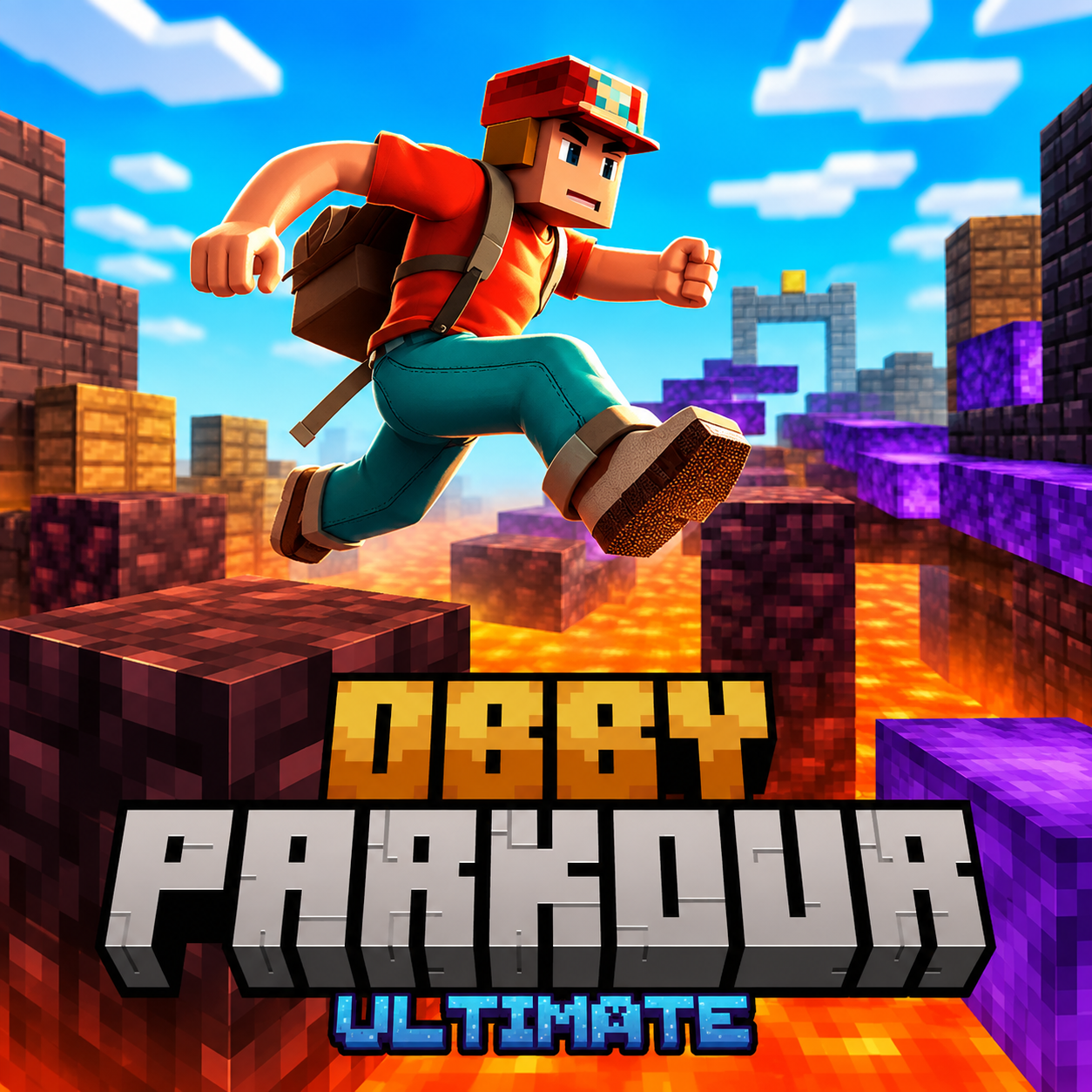
- Obby Parkour Ultimate: Work through 35 vibrant parkour stages, dodge traps, gather coins, and unlock extra characters.
- Ragdoll Parkour Simulator: Ascend a suspended 3D route filled with narrow beams, unsteady platforms, vertical constructions, and wide openings.
- Only Up: Undertake a single uninterrupted climb across pipes, trains, beams, and floating objects, where a fall can wipe out a substantial portion of your progress.
Q: What categories does Obby Tower belong to?
A: Obby Tower falls under the Adventure, jumping, 3D, parkour, and skill game categories.
Q: What happens if I fall after passing a checkpoint?
A: If you fall after activating a checkpoint, you will resume from the most recent one instead of being sent back to the course's beginning.