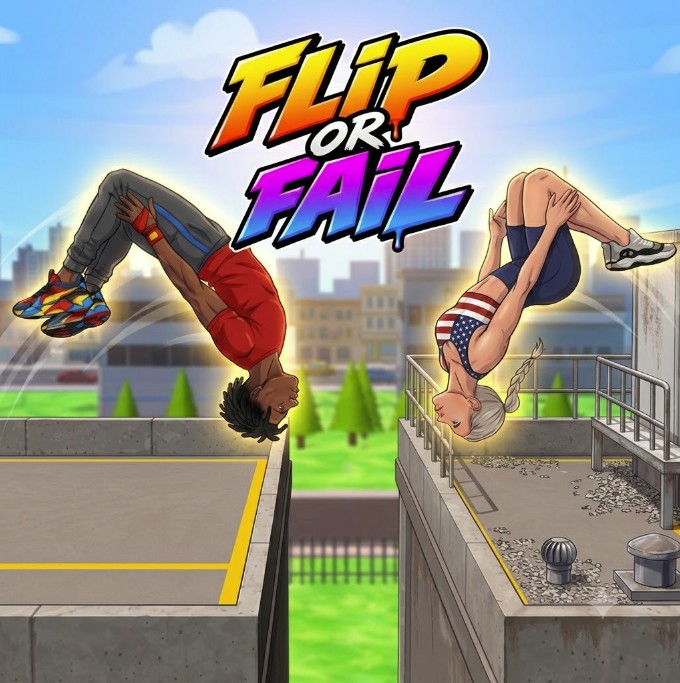
Flip Or Fail
Flip Or Fail Mods Game










How To Play Flip Or Fail
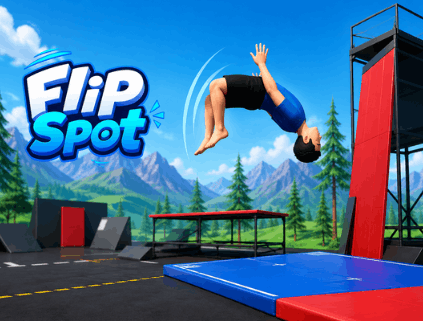
The basic interface of Flip Or Fail is highly approachable, employing a simple control layout that enables the player to concentrate entirely on the physics governing the acrobatic maneuvers. The main commands consist of triggering and adjusting a leap to propel the athlete skyward. After leaving the ground, the player must control the character's spin using these basic inputs, accumulating velocity and angular momentum to perform a full backward somersault. The core gameplay element revolves around evaluating the rotational speed and identifying the ideal instant to halt the spin for touchdown. The triumph in the "Fail" aspect of the title depends on the player's ability to precisely time the touchdown, ensuring the feet make contact with the ground inside the specified area while the character's body remains perfectly upright. On the other hand, failure results when the player miscalculates the spin, causing the character to land on his head, his back, or to slide clumsily off the platform's edge.
As players advance through the game's levels, the design of each stage grows more challenging. Landing areas may become smaller, gaps between platforms widen, and environmental hazards can change the player's strategy. Consequently, while the fundamental controls stay consistent, mastering them requires greater subtlety. Players need to grasp the distinctive sensation of the game's physics, comprehending how fast the character speeds up his rotation and how the airborne motion is influenced by the initial leap. The approach relies heavily on trial and error; initial mistakes are anticipated as players refine their timing perception. Achieving success in Flip Or Fail does not revolve around high scores or stylistic deviation, but rather on absolute precision—determining the correct instant to start the jump, the appropriate length of the flip, and the proper moment to let go of the controls to accomplish a flawless, stable landing.
Flip Or Fail Wiki
Summary
Flip Or Fail stands as a singular and captivating addition to the world of web-based athletic and free-running games. Fundamentally, it is a physics-driven acrobatic trial that revolves around a seemingly straightforward goal: perform a backflip and touch down securely on both feet. The experience merges the thrill of extreme street sports with a whimsical, ragdoll-inspired physics system, yielding a blend that is both skill-intensive and delightfully humorous. Players command an agile gymnast who traverses an escalating series of intricate environments, where the primary test lies in coordinating leaps and mid-air spins to achieve a clean, vertical halt within a marked landing zone. The contrast between graceful, polished flips and the potential for comical, ragdoll-style mishaps forms the very core of the gameplay loop. This dynamic ensures that both the triumph of a successful trick and the absurdity of a botched attempt are equally entertaining, fostering a persistent "just one more try" mindset. Designed as a solo endeavor, the game eliminates complex multiplayer elements to concentrate solely on the player's growing proficiency in movement, timing, and spatial judgment. The "urban extreme" aesthetic, rooted in street sports culture, provides a suitably gritty and fashionable backdrop for what is ultimately a game of precise physics and acrobatic trial-and-error.
Key Features
Although the premise may seem minimal, the feature set is meticulously crafted to deliver a focused and enjoyable challenge. The standout attribute is its Parkour-Inspired Gameplay, which facilitates stylish aerial maneuvers that extend beyond basic jumps. The inclusion of Backflip Challenges serves as the central gameplay hook, rewarding players for achieving the maximum rotation without overshooting the target zone—a distinct visual and spatial test. This is further enhanced by the Urban Extreme Style, a visual theme derived from street sports, giving the game a unique stylistic identity. The game operates on Physics Fun, where the character's interactions with the environment are governed by responsive systems that determine the difference between a graceful stunt and a crumpled failure. This is complemented by A Single-Player Experience devoted to self-improvement and mastery, allowing players to refine their focus without external distractions. Finally, the control scheme is briskly effective; the Simple Controls provide an immediate welcome, enabling newcomers to grasp the fundamentals, while the nuanced physics offer depth that will appeal to hardcore gamers seeking a demanding, precision-centric gameplay loop.
Precautions/Tips
For those aiming to transition from casual play to true acrobatic consistency within Flip Or Fail, several strategies can significantly reduce early frustration. First and foremost, understanding the physics of trajectory is essential. As soon as the character launches, the player must be proactive in initiating the flip. Delaying this input results in a trajectory too low to complete, making timing crucial. The key lies in the release point. Pay close attention to the character's head and torso orientation; you should stop the rotation the moment the character is vertically aligned with the world, directly above the landing platform. It is often better to feel as though you are stopping slightly early or late, as the gradual learning curve teaches the difference between a near-miss and a slam.
Preparation is also vital. Familiarize yourself with the designated landing area. It is not enough to land on your feet; you must land upright specifically within this zone. A successful landing requires both a full rotation and proper physical alignment within the area. Later levels accelerate the action, so do not underestimate the value of maintaining a steady hand; rushed controls frequently lead to over-rotation and face-flat failures. Additionally, be mindful that the game is entirely about single-player progression; if a stage becomes frustrating, it is best to step back mentally and approach each run with a fresh perspective, focusing on the singular goal of a clean, safe landing. While the game features amusing ragdoll failure animations, the true satisfaction comes from the consistency of the upright dismount. There are no sequences or complex inputs to learn—the real challenge is a mind-body synchronization, so concentrating your entire attention on the timing of the rotation is the only way to ensure your safety from the "Fail" in the title.
Flip Or Fail Frequently Asked Questions
Q: What is Flip Or Fail?
A: Flip Or Fail is an online parkour acrobatics game that runs directly in your web browser. The core activity involves executing backward somersaults and striving to touch down securely on both feet without stumbling.
Q: How do I win or complete a level?
A: To clear a level, you must successfully perform each stunt by managing your character's leap and ensuring that you land in an upright posture within the specifically marked zone.
Q: What are the controls?
A: The game relies on straightforward movement inputs to initiate and guide your flips. These controls are intuitive, allowing you to focus on the timing of your aerial rotations.
Q: Is Flip Or Fail difficult?
A: While the fundamental concept is simple to grasp, the difficulty escalates as you progress. Later stages demand increasingly precise timing and refined control over your character's movements.
Q: Can I play alone?
A: Absolutely. Flip Or Fail is exclusively designed as a solo gaming experience, with no cooperative or competitive multiplayer elements.
Q: What is the visual style of the game?
A: The game adopts an urban extreme aesthetic, heavily inspired by street sports culture. This is reflected in the gritty cityscapes, graffiti-like accents, and the overall edgy, athletic vibe.
Q: What makes the game entertaining?
A: The entertainment value stems from a delightful combination of parkour stunts, physics-driven motion, comical body positions, and the humorous outcomes of failed landings. These elements keep the gameplay lighthearted and engaging.
Q: What is the core gameplay mechanic?
A: You take command of a nimble gymnast who must navigate through various settings, perform mid-air rotations, and conclude each challenge by landing upright. The mechanic revolves around mastering the physics of your jumps and spins.
Q: What is the goal of each level?
A: The primary objective in every level is to leap, execute a flip, and land on your feet within the designated landing zone. Precision and accuracy are key to achieving success.
Q: What skills are most important?
A: Timing stands out as the most critical skill. You must accurately gauge your character's spin speed and release the movement input at the exact moment to ensure a clean, upright landing.
Q: Are there different environments in the game?
A: Yes, the game features a variety of distinct environments that you must traverse. However, the available information does not provide detailed descriptions of each specific setting.
Q: What happens when you fail a flip?
A: When you botch a flip, the result is often a series of awkward and amusing poses. These comedic failures are intentionally integrated into the game, turning mistakes into a source of entertainment.
Q: Is there any multiplayer mode?
A: No, Flip Or Fail offers no multiplayer functionality whatsoever. It is strictly a single-player affair, focusing entirely on individual skill and progression.
Q: What type of game is Flip Or Fail?
A: Flip Or Fail is a parkour-inspired title that centers on backflip challenges, physics-based movement, and the necessity of precise timing. It blends athletic agility with playful physics to create a unique and enjoyable experience.