Park Fever
Park Fever Mods Game






















How To Play Park Fever
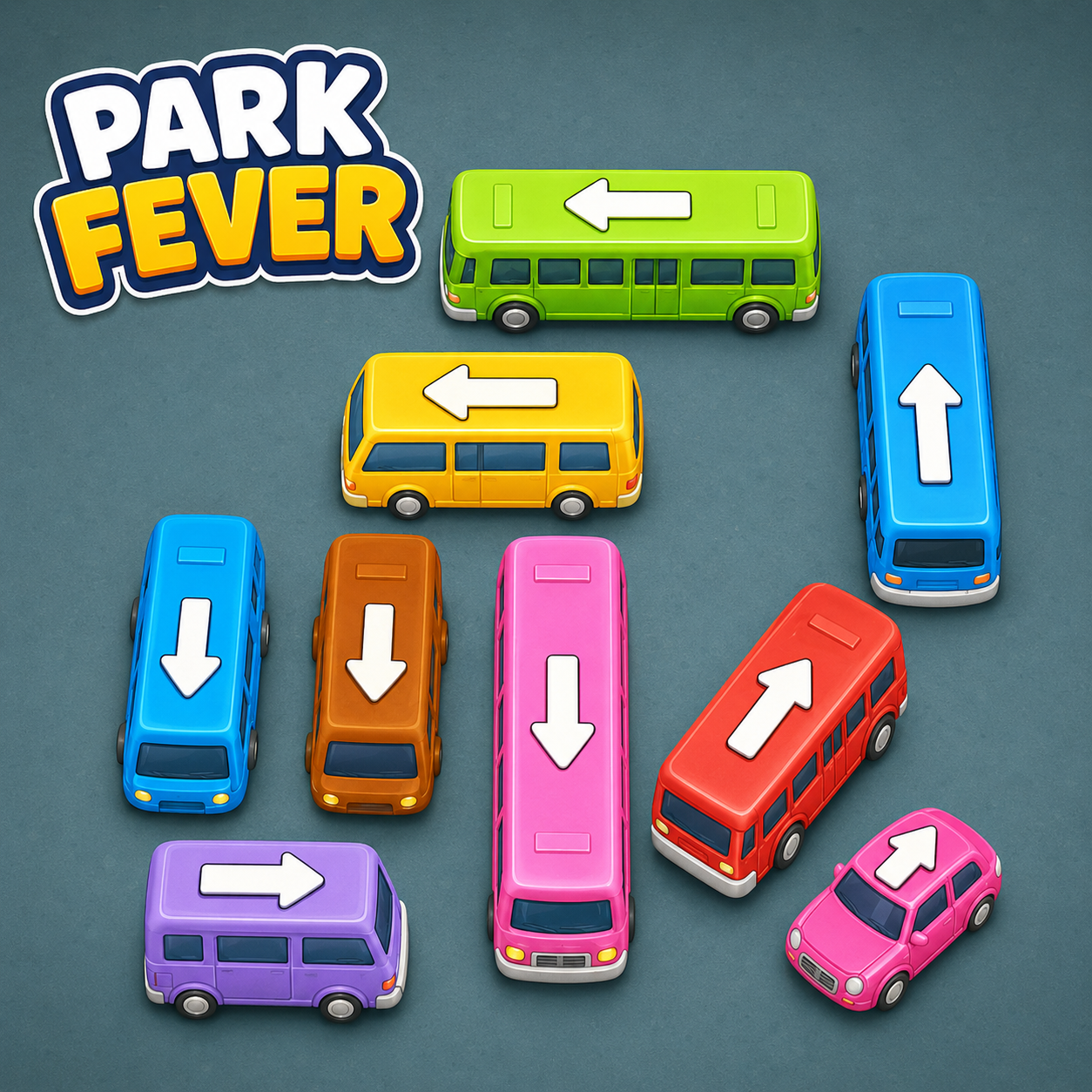
In Park Fever, the central gameplay mechanic revolves around selecting an unobstructed car by clicking or tapping and guiding it out of the parking zone. Every vehicle features a directional indicator that determines its permitted route; if another automobile blocks that path, the car remains stuck in place. A notable element of the gameplay loop is the chain reaction triggered by freeing space—removing a vehicle near the edge can open an escape route for multiple cars previously trapped deeper inside the lot. After leaving the parking area, each vehicle is sent to one of the open bays located alongside the passenger waiting line. The interaction rules follow a strict color-matching system: riders may board only a vehicle whose color corresponds to their own, and every car has a finite carrying capacity.
Strategic depth emerges primarily from the passenger queue. Since riders are served strictly from the front of the line, players cannot arbitrarily bypass one color to accommodate a group positioned further back. This demands continuous monitoring of the upcoming passenger colors to determine which vehicles need to be navigated toward the boarding station. The capacity limitation introduces an additional layer of complexity—a smaller car might accommodate only a fraction of a large waiting group. In such cases, a second vehicle of the identical color must be released before the next segment of the queue can begin boarding, thereby preserving the correct order of service. This dynamic creates an ongoing mental cycle of planning, execution, and reassessment, keeping players engaged throughout each level.
Park Fever Wiki
Summary
Park Fever, developed by GameBerry Studio, is a thoughtfully constructed traffic-management puzzle game that tasks players with coordinating the methodical exit of vehicles from increasingly intricate parking zones. Each level presents a series of intellectually demanding scenarios in which a congested parking area, multiple staging bays, and a line of color-coded passengers combine to form a dynamic and ever-shifting puzzle environment. The core objective appears simple but proves surprisingly challenging: dispatch cars in the proper order and ensure that every passenger successfully leaves the station. Although the controls are refreshingly straightforward, the level layouts require considerable strategic foresight and deliberate planning. Players must continuously assess which vehicles are eligible to leave based on their directional indicators, which passenger colors are next in the queue, and how much open capacity remains in the restricted holding areas. Park Fever sets itself apart through its smooth integration of spatial reasoning and sequence-based problem-solving, delivering a satisfying mental workout for puzzle enthusiasts who value complexity that emerges from elegantly simple mechanics.
Key Features
Park Fever boasts several standout features that reinforce its reputation as a compelling puzzle experience. Above all, it introduces a distinctive spatial puzzle mechanic in which every action carries consequences. The directional arrows and obstruction rules compel players to anticipate multiple moves in advance, much like a sliding-tile puzzle, yet wrapped in a coherent and logical traffic-management theme. The game skillfully incorporates a passenger queue system, adding a sequential reasoning component that prevents solutions from merely being a matter of clearing every car from the lot. This fusion of spatial navigation and ordered dispatch ensures that no two levels feel monotonous, given the enormous variety of possible arrangements involving vehicle positions, bay capacities, and passenger sequences.
The gameplay is built for cross-platform accessibility, featuring intuitive controls that work smoothly on both desktop and mobile interfaces. On a computer, players simply click a vehicle with the left mouse button, while on a touchscreen device, a quick tap accomplishes the same action. This direct control scheme guarantees that the challenge originates from the puzzle design itself rather than from awkward or overly complex mechanics. Additionally, the difficulty progression is meticulously balanced. Early stages introduce fundamental concepts within a forgiving setting, whereas later levels feature considerably more crowded parking configurations and a wider range of passenger colors. This gradual escalation sustains player engagement by continuously presenting fresh obstacles that test the ability to juggle multiple constraints at once and devise efficient pathways for the safe departure of every vehicle.
Precautions/Tips
To achieve success in Park Fever and minimize frustration, players should observe several important strategic precautions. One of the most frequent errors is poor management of the holding bays. Vehicles that do not match the passengers currently waiting in the queue must be placed in these bays, and available space is extremely limited. Releasing too many cars intended for future passenger groups in an effort to empty the lot can rapidly clog the station with vehicles that cannot be used at the moment. The level ends in failure when every bay is occupied and none of the parked cars can accommodate the passengers at the front of the line. Consequently, it is essential to preserve at least one empty bay whenever feasible, serving as a safety margin that prevents an immediate deadlock.
Another vital piece of advice is to exercise restraint: avoid moving a vehicle unless it directly assists the current queue or opens up a critical pathway. Activating a car without a well-defined plan often worsens the congestion, consuming a bay unnecessarily and blocking potential routes for more pertinent vehicles. Pay close attention to the capacity of each car in relation to the waiting passenger groups. If a substantial cluster of, for example, red passengers is next in line, make sure enough red vehicles have been released to transport all of them before proceeding to the next colored group. Finally, although boosters become available in later stages and can help correct mistakes, they should not be treated as a primary solution. The most dependable route to mastery lies in carefully observing the queue order, thoughtfully planning each vehicle's movement, and maintaining acute awareness of spatial limitations. Always think several steps ahead and survey the entire grid before initiating a series of actions, so that you can achieve an efficient and successful outcome.
Park Fever Frequently Asked Questions
Q: What is Park Fever?
A: Park Fever is a puzzle centered on traffic flow and organization, created by GameBerry Studio. Every stage includes a congested parking zone, several waiting areas, and a line of passengers distinguished by color.
Q: What is the goal in Park Fever?
A: The objective is to dispatch cars in the proper sequence so that all travelers can depart from the station.
Q: How do I move a vehicle out of the parking area?
A: Select an unobstructed vehicle with a click or tap to drive it out. Since every car moves only in the direction indicated by its arrow, a blocked path prevents departure.
Q: How do passengers board vehicles?
A: Boarding is limited to vehicles matching the passenger's color, and each car has a maximum occupancy. Because passengers board in queue order, you cannot bypass one color to reach a later group.
Q: What are holding bays used for?
A: Cars that do not correspond to the current passengers must be placed in the holding bays. These slots are finite, so moving out too many future-colored vehicles can rapidly jam the station.
Q: When does a level fail?
A: A level ends in failure when all holding bays are full and no parked car can accommodate the passengers at the front of the line.
Q: What happens if a vehicle can only carry part of a group?
A: A smaller car might transport only a portion of a large group. In such a situation, an additional vehicle of the same color is required before the following group can start boarding.
Q: What controls are available on desktop and mobile?
A: On desktop, use the left mouse button to click a vehicle. On mobile, simply tap the vehicle you wish to choose.
Q: What do boosters do in the game?
A: Boosters can assist in fixing errors, though careful sequencing of your actions remains the surest path forward.
Q: How do later levels differ from earlier ones?
A: Advanced stages feature more tightly packed parking layouts and a greater variety of colors.
Q: Can a vehicle leave if another car is in its way?
A: Absolutely not. Each car follows the arrow's direction, meaning any obstruction in its path will stop it from exiting.
Q: What should I check before selecting a vehicle?
A: Before choosing a car, examine the colors of upcoming passengers and verify that the necessary vehicles can actually reach the station.
Q: Why should I keep a holding bay space open?
A: It is wise to maintain at least one empty holding bay whenever possible, since the level is lost when every bay is occupied and none of the parked cars can serve the waiting passengers.
Q: What is the most reliable way to progress in the game?
A: The most dependable strategy is to plan your moves in advance and execute them in the right order.