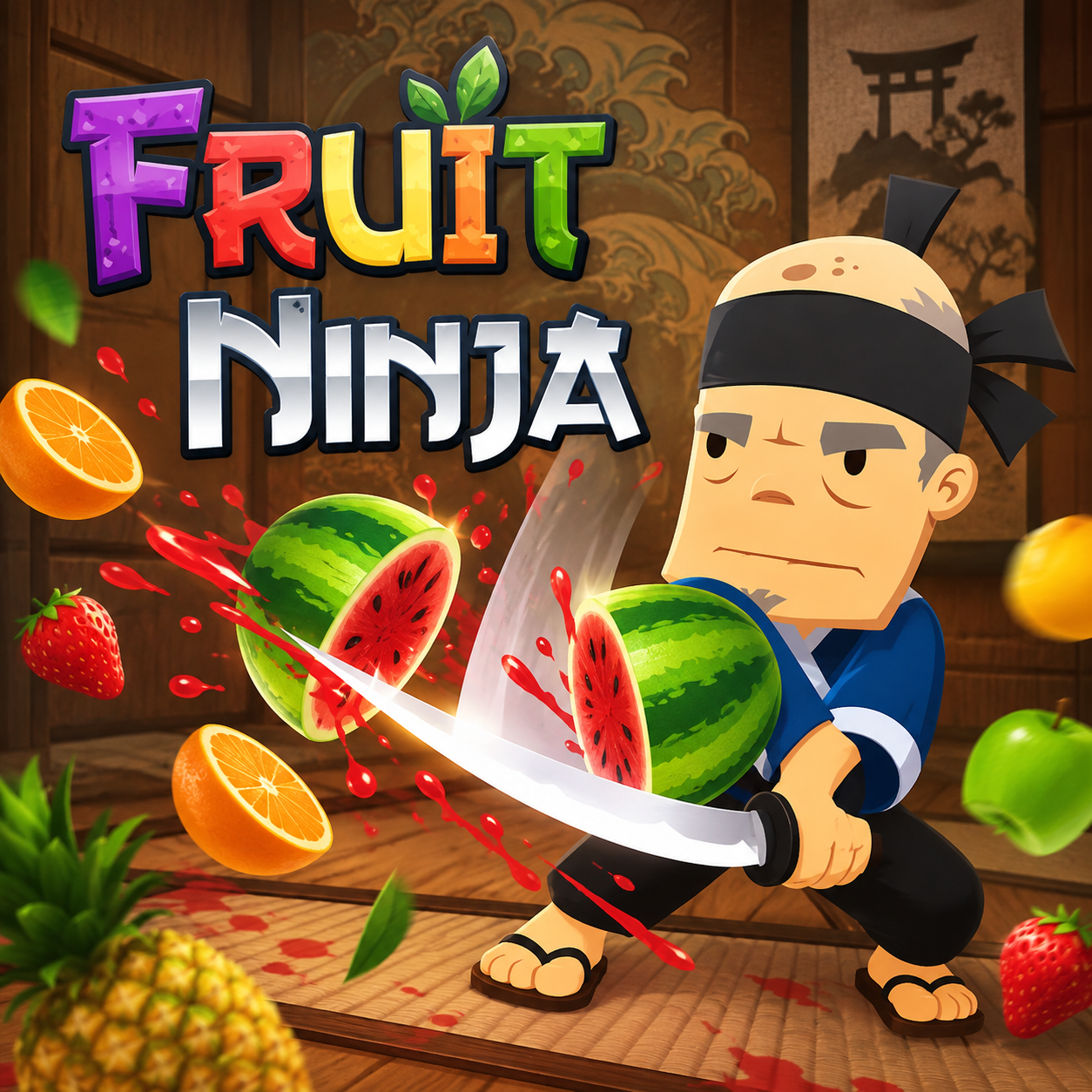
Fruit Ninja
Fruit Ninja Mods Game
Zombie Battle Royale

Dash Masters
Zombie Dash
Rainbow Tsunami
Shapik The Quest

Do Dragons Exist
Goat Rampage
Tower Rise

Horror Nun 2

Sprunki Square Shifted
Obby Survive Parkour

Bees Empire Clicker

Paint Or Hunt

Super Bear Adventure
Brave Squad

Sprunki Hyper Shifted Phase 3 Remastered

Left Or Right Spranki Beats

1 Speed Keyboard Lucky Escape
Traffic Racing
Rider Rush




How To Play Fruit Ninja
The fundamental gameplay of Fruit Ninja is straightforward to learn, but achieving mastery is far from trivial. Fruit is propelled upward from the lower portion of the display, and the player's task is to cut it mid-air. Every item travels along a curved flight path: it ascends, decelerates near the highest point of its motion, then picks up speed as it falls. In order to slice a piece, the blade must be drawn across the fruit's on-screen shape. With a desktop setup, this involves pressing and holding the left mouse button while guiding the cursor. On touch devices, a simple finger swipe accomplishes the same action.
The trajectory of the blade is every bit as critical as the moment of the strike. Since the slicing motion is unbroken, one continuous sweep can travel through numerous fruit items along its route. This mechanic serves as the basis of the combo system. Cutting several targets during a single gesture yields a higher score than dealing with them one by one, and experienced players deliberately arrange their swipes to pass through multiple objects simultaneously. Yet caution is essential, because bombs also appear on the field. These dangerous items have a clear visual identity; in Classic mode they terminate the session outright, whereas in Arcade mode they deduct points. A sweeping, careless motion may strike an explosive that was merely positioned near the intended cutting line.
Successful play starts with careful observation. Given that fruit loses momentum around the apex of its flight, that particular instant is usually ideal for assessing its exact location and selecting a secure cutting angle. By delaying just a fraction of a second, several pieces may converge in the air, which makes an angled stroke especially rewarding. On the other hand, excessive hesitation can cause a target to descend beyond reach and be missed entirely. Every action therefore demands a balance between quick reactions and precise control.
In Classic mode, the absence of a countdown encourages a more measured and patient approach. The main goal is to survive by steering clear of errors. Letting three fruit pieces drop ends the run, and contacting a bomb produces an immediate game over. Consequently, it is sometimes smarter to intentionally let a challenging fruit fall rather than slice it when doing so would pass through a nearby explosive. Zen mode, by contrast, eliminates bombs altogether, and missed fruit brings no penalty whatsoever. This creates a relaxed, stress-free setting where players can concentrate on fluid, accurately timed strokes and refine their ability to group several targets into a single combo.
Arcade mode alters the dynamics by adding a ticking timer and a scoring penalty whenever a bomb is hit. Because fallen fruit is ignored, the player is free to prioritize rapid scoring above all else. Additional strategic depth comes from special bananas, including Freeze and Double Points. Freeze temporarily reduces the speed of the action, while Double Points increases the value of every fruit cut while the effect is active. Deciding when to pursue these power-ups and when to simply sustain the combo chain is an essential skill for mastering Arcade mode.
Fruit Ninja Wiki
Summary
Fruit Ninja is an exacting action title that refines the classic slicing gameplay into a challenge of timing, spatial awareness, and deliberate force. At first glance, the concept is straightforward: fruit is tossed skyward, and the player must cut as many segments as possible while steering clear of dangers. Yet the real complexity rests in interpreting the flight path of each object on the display, determining when to unleash a sweeping slash, and recognizing when one precise cut is more valuable than an ambitious strike across several fruits.
The blade in Fruit Ninja mirrors the exact route drawn by the mouse or fingertip, making each slash a pure reflection of the player's intent. Fruit ascends from the lower screen, slows down as it reaches the peak of its trajectory, and then descends beyond reach. This produces a predictable cadence: early cuts are safe but yield little, whereas waiting for several fruits to converge creates the chance for higher combo scores. Bombs are inserted into the aerial mix and must never be touched, adding a layer of risk evaluation to every choice.
Fruit Ninja provides three separate play modes, each defined by unique goals and scoring logic. Classic mode focuses on endurance with no timer, concluding only after three fruits are dropped or a single bomb is struck. Zen mode offers a 90-second stretch free of bombs, designed for those who wish to refine clean execution and combo sequences. Arcade mode is a 60-second burst in which dropped fruit carries no consequence, bombs subtract points instead of terminating the session, and bonus bananas can dramatically shift the tempo. Collectively, these modes turn a basic cutting action into a flexible test of skill that welcomes both careful planners and daring high-score hunters.
For dedicated players, Fruit Ninja is much more than a simple distraction. It rewards the ability to recognize patterns, coordinate hand and eye, and make disciplined choices. The controls are instantly intuitive, yet the scoring mechanics and bomb arrangements demand continuous focus and purposeful training for true mastery.
Key Features
The core design of Fruit Ninja rests on a compact collection of essential elements that deliver an unexpectedly sophisticated gaming experience. The most apparent element is the natural swipe-based cutting control. Given that the blade follows the player's input path exactly, there is no character animation or delayed projectile standing between intention and execution. This direct response scheme makes the game easy to enter while preserving a genuine skill ceiling for advanced play.
The three available modes are essential to the game's charm. Classic mode presents an endure-as-long-as-possible objective. With no clock, every action matters: a single wrong move can eliminate the run, yet a patient and methodical approach can stretch it out indefinitely. Zen mode offers a calm 90-second session without bombs or penalties for misses. It serves as the perfect environment for learning fruit arcs and refining combo timing. Arcade mode, on the other hand, is a 60-second scoring rush. The absence of missed-fruit penalties encourages boldness, while the point deduction for bombs discourages complete recklessness.
Combo scoring stands out as another vital feature. When the player slices multiple fruits with one continuous stroke, the payoff is considerably greater than the sum of separate cuts. This pushes the player to think in terms of whole patterns rather than isolated slashes. High-performing games are constructed around long, purposeful diagonal movements that cross the upper region of the screen, where fruit tends to gather. Maintaining precision while moving at speed adds a constant intellectual challenge.
Bombs introduce a risk-versus-reward layer to every stroke. These hazards are intentionally placed among the fruit, forcing the player to track the entire playfield at every moment. In Classic mode, touching a bomb is instant death. In Arcade mode, bombs lower the score but allow the round to continue. This distinction shapes how the player approaches each mode: caution governs Classic, while measured risk-taking defines Arcade.
Finally, the cross-platform controls make Fruit Ninja a highly adaptable experience. The game performs equally well on a computer using a mouse or on a touchscreen using a finger. The fundamental mechanics stay unchanged, so skills gained on one system transfer directly to the other. This ease of access, combined with the intricacy of the scoring systems, makes Fruit Ninja a rewarding choice for gamers who appreciate titles that are simple to start but difficult to truly master.
Precautions/Tips
The primary caution in Fruit Ninja is to inspect the entire path before starting a cut. Since the blade slices everything along its route, a broad or careless swipe can easily connect with a bomb. Before committing, the player should mentally draw a line from the intended starting point to the finish and confirm that every target along that line is safe. If a bomb sits near a cluster of fruit, shorten the stroke and accept a smaller combo. A reduced score is always better than losing the entire round.
In Classic mode, staying alive should be the top priority. The game does not stop when a single fruit goes missed; it ends only after three misses or a single bomb hit. Therefore, a deliberate miss can sometimes be the smartest play. If a fruit is placed right next to a bomb, or if the only route to it requires crossing an explosive, letting that fruit drop is preferable. Taking one miss is far less damaging than ending the run on a bomb. Beginners often try to cut every piece of fruit on screen, but seasoned players recognize that certain fruit is deliberately arranged as a trap.
Zen mode represents the safest venue for practicing and improving technique. With bombs removed and no penalties for missing fruit, it isolates the essential skills of timing and combo creation. Players who have trouble striking multiple targets should use Zen mode to test various swipe angles and stroke lengths. Watch closely for the point where fruit reaches its slowest speed, because that moment offers the easiest interception. Practicing diagonal cuts from the lower corners toward the upper middle assists in developing the muscle memory needed for impressive scores.
In Arcade mode, the emphasis is on scoring speed, yet bombs should not be disregarded. A bomb costs only 10 points, whereas a successful combo can generate far more. This means a risky slash is sometimes justified if it produces a large multi-fruit combination. Still, players should avoid needless bomb contact, particularly when the Freeze or Double Points banana is active. During a Double Points bonus, every fruit counts twice, so steering clear of bombs becomes even more critical. Save aggressive moves for situations where the potential reward clearly outweighs the downside.
Finally, keep in mind that the blade can be as exact or as wide as the player desires. Short, quick strokes work well in packed zones where bombs may be concealed. Longer strokes build greater combo momentum but cover more territory and thus carry greater risk. Adjust the length and direction of each swipe according to the current layout. By remaining flexible and always reading the screen before cutting, players can convert a simple gesture into a high-scoring performance that avoids bombs entirely.
Fruit Ninja Frequently Asked Questions
Q: What is Fruit Ninja?
A: Fruit Ninja is an arcade title centered on reflexes, in which players cut through produce launched into view, assemble multi-hit chains, and steer clear of explosives hidden among the items. The game includes three distinct play modes, each governed by its own set of rules to deliver a range of experiences.
Q: What are the three game modes in Fruit Ninja?
A: The three available modes are Classic, Zen, and Arcade. Classic imposes no timer, concluding only when the player has missed three pieces of fruit or struck a bomb. Zen provides a 90-second session without any bombs and imposes no penalty for failing to slice fruit. Arcade is a 60-second contest centered on racking up points; dropped fruit carries no penalty, while hitting a bomb subtracts 10 points.
Q: How does Classic mode work?
A: In Classic, there is no set duration. The game continues until three fruit are missed or a bomb is sliced, unless a protective item intervenes. Maintaining precision is key to extending the session; at times, allowing an awkward fruit to fall is safer than slashing through an explosive.
Q: How does Zen mode work?
A: Zen mode lasts for 90 seconds, eliminates bombs entirely, and does not penalize missed fruit. It is intended for honing clean swipe technique and grouping several targets into combos, free from concerns about survival.
Q: How does Arcade mode work?
A: Arcade is a 60-second scoring sprint packed with bonus actions and without penalties for drops. Bombs are not fatal; they simply take 10 points off your total. As a result, the main objective is to accumulate points as rapidly as possible while minimizing costly errors.
Q: What are the controls on desktop?
A: When playing on desktop, press and hold the left mouse button, then move the cursor through fruit to perform slices.
Q: What are the controls on mobile or tablet?
A: On mobile or tablet, run your finger across the display to cut through fruit.
Q: How do combos work in Fruit Ninja?
A: The blade traces exactly the path you make, so a single continuous motion can pass through multiple pieces and generate combo points. Broad diagonal strokes are especially effective for catching several fruit at once when the screen is unobstructed.
Q: How do bombs affect gameplay?
A: Bombs add a layer of timing difficulty. One sweeping gesture might collect an entire cluster of fruit, but it can just as easily hit an explosive sitting nearby. In Classic mode, contacting a bomb immediately ends the match. In Arcade, a bomb costs 10 points rather than terminating the run. Zen mode contains no bombs at all.
Q: What are the Arcade bonus items?
A: Arcade mode features Freeze and Double Points bananas. Hitting Freeze decelerates the gameplay, while Double Points temporarily increases the points you can earn.
Q: How does fruit movement work?
A: Fruit launches from the lower part of the display, reaches the peak of its trajectory, and then drops beyond reach. As fruit approaches the top of its arc, it becomes simpler to follow, making that phase an ideal opportunity to plan your slicing angle.
Q: What tips are there for a higher score?
A: To improve your score, try lining up combos with long diagonal swipes, inspect the path for bombs before committing to a cut, give priority to Arcade power-ups such as Freeze and Double Points bananas, and use Zen mode to study fruit flight paths and refine timing before moving on to Classic or Arcade.
Q: When is the best time to strike fruit?
A: Slicing right away helps hit a single item, while pausing briefly can bring several targets within reach of one swipe. When fruit nears the peak of its arc, tracking is easier, so that is a good moment to calculate your approach angle.
Q: Should I always go for large combos?
A: Not necessarily. Always examine the complete route before slicing, and use shorter strokes when explosives are close to the fruit. A strong run depends on judging when a big combo justifies the danger, particularly with bombs nearby.