Tapus Skating Adventure
Tapus Skating Adventure Mody do gry
Smush
Ślimak Bob 8
Airborne Bmx
Hexbound
Mr Macagi Adventures

Poople
Brainrot Hole
Color Tunnel 2
Battalion Commander 2
Flowball
Sprunki Cute Time Ultimate
Sprunki Summer Time

Sprunki Fire Warm
Sprunki Jevin Treatment
Sprunkilarity3
Hill Sprint
Koci Symulator Życia
Fireboy And Watergirl 6 Bajki
Baldis Basics Classic Remastered
Mineland
Jak grać Tapus Skating Adventure
Podstawową interakcją w Tapus Skating Adventure jest ollie, pojedyncza czynność kontrolująca cały ruch pionowy. Na komputerze naciśnięcie spacji uruchamia skok; na urządzeniach mobilnych stuknięcie w dowolnym miejscu ekranu wykonuje tę samą funkcję. Ten projekt oparty na jednym przycisku oznacza, że każda decyzja koncentruje się na kiedy nacisnąć, a nie na którego przycisku użyć.
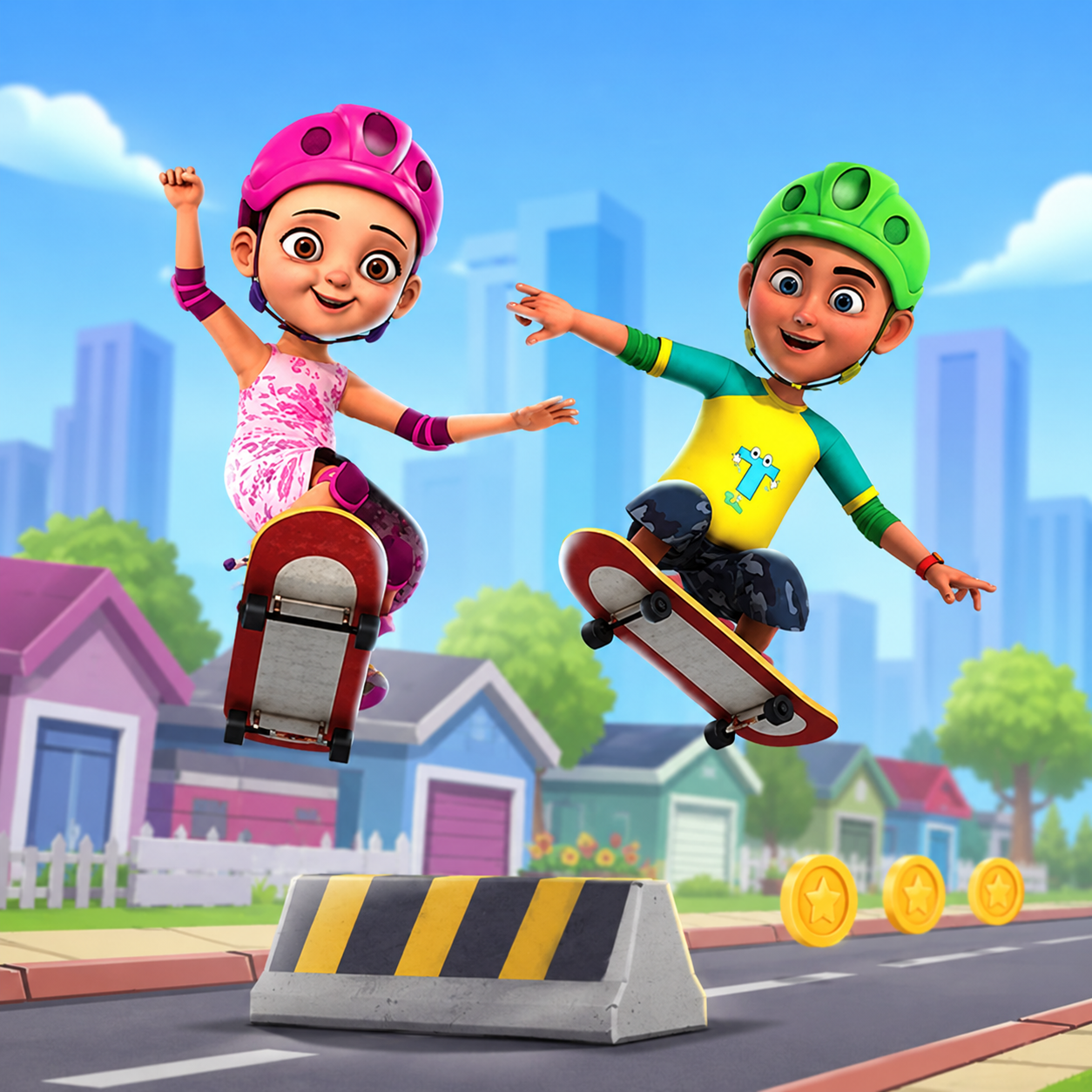
Tappu automatycznie toczy się do przodu wzdłuż prostej miejskiej trasy. Twoją rolą jest podjęcie decyzji o dokładnym momencie, w którym odrywa się od ziemi. Tor jest wypełniony różnorodnymi statycznymi przeszkodami: ławkami, koszami na śmieci, pachołkami drogowymi i innymi przedmiotami ulicznymi. Niektóre z tych przeszkód można pokonać podstawowym, dobrze wycelowanym skokiem, podczas gdy inne są niższe i wymagają późnego wzniesienia, aby uniknąć uderzenia deski. Trudność polega na odczytywaniu każdego ha
Tapus Skating Adventure Wiki
Summary
Tapus Skating Adventure presents a vibrant, fast-paced skateboarding experience built around a deceptively simple one-button control scheme and a relentless emphasis on timing. Players take on the role of Tappu, a character who sets aside his usual cricket pursuits to embark on an obstacle-laden urban run on a skateboard. The core objective is straightforward: navigate a busy city course, perform ollies at precise moments, collect coins and alphabet pickups to boost the score, and avoid a collision that ends the run. While the controls are immediately accessible, the game’s depth emerges from the need to read each obstacle early, gauge the correct jump timing, and balance the temptation of high-value collectibles against the imperative of a safe landing. Success depends not on rapid button mashing, but on deliberate, well-calibrated inputs that account for the changing distance and positioning of hazards. The game’s difficulty escalates through sections that require consecutive jumps, the use of trampolines to extend aerial travel, and arrangements of street furniture such as benches, trash cans, and traffic cones that each demand a unique approach. With its bright color palette, straightforward scoring system, and clear feedback on each attempt, Tapus Skating Adventure offers a satisfying challenge for players who appreciate skill-based endless runners that reward observation over reflexes alone.
zard far enough in advance to react. Jumping too early may cause Tappu to land directly in front of the obstacle; jumping too late results in a collision before he gains sufficient height. Certain segments feature gaps that demand a precisely executed ollie, and others include trampolines positioned to launch the player across extended sections—these should be used as distinct mechanical tools rather than treated like ordinary obstacles.
Coins are scattered throughout the route, often placed on trajectories that encourage higher or more risk-laden paths. Alphabet pickups (letters) add an additional layer of scoring, rewarding players who deviate from the most direct line through the course. Collecting these items improves the total score, but chasing every coin or letter may place Tappu in a poor position for the next obstacle. A clean run thus requires constant forward planning: you must evaluate whether the reward is worth the risk, where Tappu will land, and whether there is enough time to prepare for the upcoming hazard.
Repeatedly pressing the jump button without observing the course is ineffective because every jump changes Tappu’s position, speed, and landing time. Consecutive obstacles may require multiple jumps in quick succession, and the trampolines offer extended airtime that must be used to clear longer sequences. The game never requires complex button combinations or directional inputs; mastery comes entirely from timing discipline and spatial awareness.
Key Features
- One-Button Control System – The entire gameplay loop revolves around a single input (spacebar or tap). This minimal interaction lowers the barrier to entry while placing a premium on timing precision. The simplicity allows players to focus entirely on reading the course instead of managing multiple actions.
- Urban Obstacle Course – The environment is a busy city street filled with a varied set of everyday obstacles: benches, trash cans, traffic cones, and other street furniture. Each obstacle type presents a distinct timing challenge, and their arrangement creates dynamic, non-repetitive sequences.
- Collectible-Driven Scoring – Two types of pickups enhance the scoring system: scattered coins that reward riskier routes, and alphabet letters that contribute to a bonus score. The presence of these collectibles encourages players to explore alternative paths and make trade-offs between safety and score maximization.
- The Ollie as Core Mechanic – The ollie is not merely a jump; it is the central action that defines movement through the course. Proper use of the ollie enables obstacle avoidance, coin collection, and completion of skateboarding feats. The game offers no power-ups, alternate moves, or defensive options, making the timing of every ollie critical.
- Trampoline Integration – Trampolines are placed at strategic points to extend Tappu’s aerial movement. They function as a distinct gameplay element that must be recognized and exploited for covering larger gaps or chaining jumps together. Mistaking a trampoline for a standard obstacle leads to missed opportunities or poor landing positioning.
- Progressive Difficulty Through Consecutive Jumps – Later sections of the course introduce sequences where obstacles appear in rapid succession, requiring multiple well-timed ollies with minimal recovery time. This tests the player’s ability to maintain rhythm and adapt quickly to changing spacing.
- Clean Visual Feedback – The game provides clear on-screen cues for collisions, collectible pickups, and jump height, allowing players to learn from each attempt without confusion. The bright, cartoonish art style reduces visual clutter, keeping the focus on the obstacle layout ahead.
Precautions/Tips
- Focus on the Upcoming Obstacle, Not on Tappu – A common mistake is staring at the character while he is in the air. Instead, train your eyes on the next hazard as early as possible. By the time Tappu lands, you should already know whether and when to jump again. This forward-looking approach reduces reaction delays and helps avoid last-second collisions.
- Prioritize a Safe Landing When a Coin Is Near a Hazard – Coins are often placed in tempting positions—directly above an obstacle or just before a gap. Chasing every coin can lead to a poorly timed landing that places Tappu exactly where the next hazard will hit. When the risk is high, skip the coin and focus on clearing the obstacle safely. One clean run with fewer collectibles is worth more than a crash caused by greed.
- Avoid Repeated Pressing; Use Deliberate Inputs – Spamming the jump button may feel intuitive, but it disrupts your sense of timing. Because each ollie changes Tappu’s trajectory and landing point, random presses make it difficult to predict where he will be. Develop a habit of pressing only when you have consciously judged the obstacle distance. This discipline makes the timing far easier to control.
- Treat Trampolines as Special Tools, Not Ordinary Obstacles – Trampolines behave differently from standard blocks. They provide a strong upward launch that can clear multiple obstacles in a single arc. When you see a trampoline, plan to use it to bypass a longer section or to reach high-placed coins. Do not waste its potential by jumping immediately before hitting it, or by treating it as just another jump pad without adjusting your approach.
- Learn from Each Crash and Adjust Accordingly – After a collision, take a moment to reflect on what went wrong. Was the jump too early, causing a premature descent? Or was it too late, resulting in a collision before liftoff? By consciously noting the error, you can adjust the timing on the next attempt. The game’s trial-and-error nature rewards deliberate analysis over repeated mindless attempts.
- Maintain a Consistent Rhythm, Especially in Consecutive Jump Sections – When obstacles appear in quick succession, strive for a steady cadence of jumps rather than panicked taps. A consistent rhythm helps you gauge spacing naturally. If a sequence feels rushed, try jumping slightly earlier than you think necessary; often the landing point will align better with the next obstacle.
- Don’t Overcomplicate the Controls – With only one button, there is no special move, double jump, or brake. Accept that the challenge is entirely about timing. Do not search for hidden mechanics or alternate inputs—they do not exist. Focusing on the fundamentals of when to press is the only path to improvement.
Tapus Skating Adventure Najczęściej zadawane pytania
P: Czym jest Tapus Skating Adventure?
O: Tapus Skating Adventure to kolorowa gra o skateboardingu, oparta na timing, szybkiej obserwacji i prostym sterowaniu za pomocą jednego przycisku. Tappu zostawia swoje zwykłe zajęcia z krykieta, chwyta deskorolkę i wyrusza w pełną przeszkód podróż.
P: Jaki jest główny cel gry?
O: Celem jest bezpieczne poruszanie się, wykonywanie olli, zbieranie przydatnych przedmiotów i zdobywanie jak największej liczby punktów, zanim kolizja zakończy próbę.
P: Jak działa sterowanie w Tapus Skating Adventure?
O: Na komputerze naciśnij spację, aby wykonać ollie. Na urządzeniach mobilnych dotknij ekranu, aby skoczyć.
P: Jakiego rodzaju przeszkody pojawiają się w grze?
O: Ławki, kosze na śmieci, pachołki drogowe i inne przedmioty uliczne przerywają trasę. Niektóre można przeskoczyć, a inne można wykorzystać jako powierzchnie do trików.
P: Jaka jest główna akcja w grze?
O: Olli jest główną akcją. Pozwala Tappu unikać przeszkód, docierać do przedmiotów kolekcjonerskich i wykonywać ewolucje skateboardowe wzdłuż trasy.
P: Jak gracze powinni wyczuć moment skoku?
O: Każdy skok musi być precyzyjnie wyliczony. Skoczenie zbyt wcześnie sprawi, że Tappu wyląduje bezpośrednio przed zagrożeniem. Zwlekanie zbyt długo może spowodować kolizję deskorolki, zanim osiągnie wystarczającą wysokość.
P: Czy w grze są trampoliny?
O: Tak, trampoliny pomagają wydłużyć ruch Tappu w powietrzu i najlepiej jest używać ich do pokonywania dłuższych odcinków, a nie traktować jak zwykłych przeszkód.
P: Jak monety wpływają na rozgrywkę?
O: Monety pojawiają się na całej trasie i zachęcają graczy do wybierania wyższych lub bardziej wymagających ścieżek. Zbieranie ich poprawia wynik, ale pogonią za każdą monetą można umieścić Tappu w złej pozycji przed kolejną przeszkodą.
P: Czym są podchwyty z alfabetem?
O: Podchwyty z literami alfabetu stanowią kolejną okazję do zdobycia punktów. Zbieranie tych liter przyczynia się do wyniku bonusowego, dając graczom powód do szukania poza najbardziej bezpośrednią ścieżką.
P: Czy jest równowaga między zbieraniem a bezpiecznym lądowaniem?
O: Tak, czysty przejazd zależy od czegoś więcej niż tylko naciśnięcia przycisku skoku, gdy pojawi się przedmiot. Musisz wziąć pod uwagę, gdzie wyląduje Tappu i czy jest wystarczająco dużo czasu na przygotowanie się do następnego zagrożenia.
P: Co się dzieje po wypadku?
O: Po kolizji przypomnij sobie, czy poprzedni skok był zbyt wczesny, czy zbyt późny, i dostosuj się przy następnej próbie.
P: Jakie wskazówki są udzielane dla płynniejszej jazdy?
O: Obserwuj nadchodzącą przeszkodę zamiast skupiać się tylko na Tappu. Priorytetem są bezpieczne lądowania, gdy moneta znajduje się blisko zagrożenia. Unikaj wielokrotnego naciskania; przemyślane naciśnięcia ułatwiają kontrolowanie czasu skoku.
P: Czy gracze mogą wykonywać skoki bezpośrednio po sobie?
O: Tak, niektóre odcinki wymagają kolejnych skoków, aby skutecznie pokonać przeszkody.
P: Jak radzić sobie z szerszymi przepaściami lub bardziej skomplikowanymi przeszkodami?
O: Szersze przepaści lub bardziej skomplikowane konfiguracje mogą wymagać drugiego naciśnięcia lub pomocy trampoliny.
P: Czy wielokrotne naciskanie przycisku skoku jest skuteczne?
O: Nie, wielokrotne naciskanie bez obserwowania trasy jest zawodne, ponieważ każdy skok zmienia pozycję Tappu i czas lądowania.
P: Na jakich platformach dostępna jest gra?
O: Gra jest dostępna na komputerach (ze sterowaniem spacją) i na urządzeniach mobilnych (z dotykowym sterowaniem skokiem).
P: Czy w grze jest funkcja udostępniania?
O: Tak, gracze mogą udostępnić grę znajomym, kopiując link do Tapus Skating Adventure.